


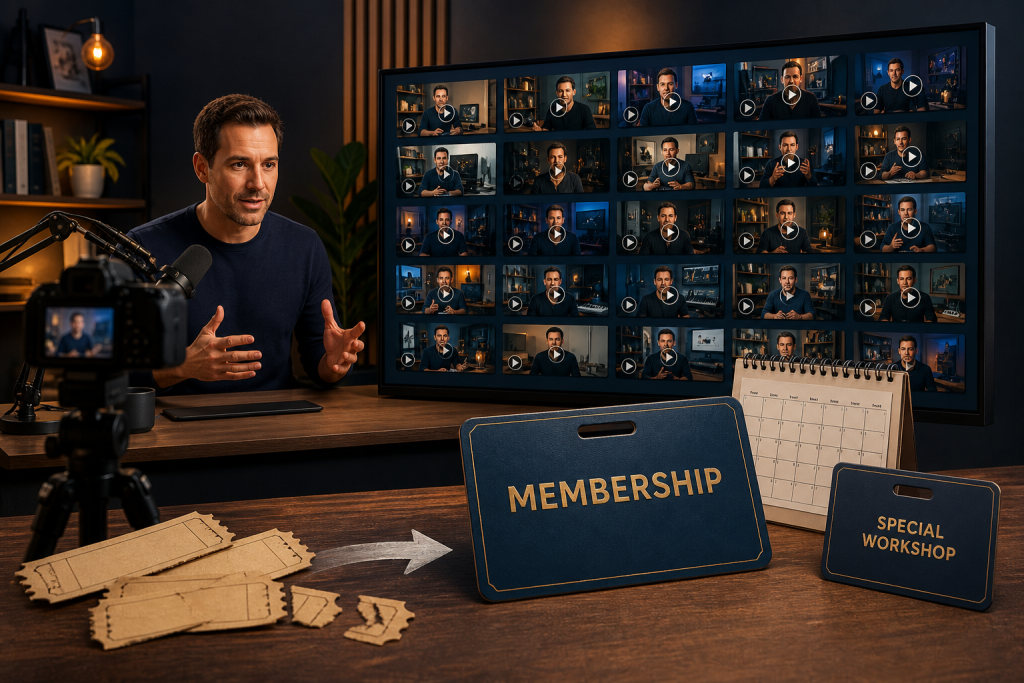
The first thing everybody does is put a price on the session.
It is the obvious move. You already sell a room and a clock, so you sell the stream the same way. One session, one ticket, thank you very much.
And it works. Twelve people pay, you go live, nobody’s microphone dies, and you close the laptop feeling like a broadcaster.
Then Tuesday arrives and you are back at zero. Not down a bit. Zero. The same zero as last month, and the month before that, and the one before that.
Which means the business you have built is a theatre that gets demolished after every performance and put up again on the Tuesday. By you. In the rain.
And the money is not even the worst of it. The worst of it is that a good week tells you nothing at all. Twelve tickets this Thursday does not predict twelve next Thursday, or four, or forty. You do not have customers. You have a run of small separate events, each one filled from nothing, forever, by a person who also has to teach the class.
I have watched a lot of people do this to themselves, and the ones who stop all do the same thing first.
They stop selling single sessions.
Nobody in this business sells one session at a time
So I went looking for the button. The one that sells you a single episode, on a service made of nothing but episodes.
Dropout is comedy television, sold today at $6.99 a month, or a year at $55.99 for the first year and $69.99 after that, or a Superfan year at $129.99. That is the entire shop. I looked for the per-episode option the way you look for your keys, which is to say twice in the same place, hopefully.
There isn’t one.
A company built entirely out of episodes will not sell you an episode. Not for any money.
Which tells you what they worked out early and what everybody else learns slowly. A single session has a ceiling, and the ceiling is the number of people who are both interested in you and free at eight o’clock on a Thursday. It is a small number. It is always a small number, and no amount of posting will make Thursday bigger.
They are paying for the weeks they miss
Here is the part that sounds like theft until you look at it properly: a good share of what a member pays you is for sessions they never watch.
They are not being robbed. They are buying a standing arrangement. The thing happens on Thursday whether or not their evening falls apart, and when it does fall apart, as evenings do, the recording is there on Saturday morning with a cup of tea. Take the recording away and you are back to selling single sessions again, because the only thing left to buy is the one they happened to be free for.
And this is the part everybody underestimates, which I can show you from our own inbox. Two of the subject lines sitting in the support queue this summer read “Storage limit” and “Recording hours”.
Nobody files those in week one. Week one is “how do I go live”. Those two arrive from somebody who has been at it for months, has quietly accumulated a body of work, and has just met the edge of it.
Mind you, a recording will not lift a finger on its own. It sits there being a file, in a folder, with a name like the date. Somebody has to decide it is worth publishing, give it a title a human would actually search for, and put it where the members can find it. That is twenty dull minutes per session, and it is the whole difference between a library and a hard drive of good intentions.
You need it working, too, because members leave. Antenna has specialty services churning at 6.6 percent a month, and it has not dropped below that since 2023. Run it through the simplest arithmetic there is and your average member stays about a year.
Not forever. A year.
So the library is not a nice extra. It is the rent.
Then sell exactly one thing on its own
Not everything. One thing.
Once a month, or once a quarter, there is something genuinely bigger than a Thursday: the long workshop, the guest who does not normally do this, the thing you spent three weeks preparing and lost a weekend to. That one gets sold separately, at a price that would look ridiculous on an ordinary evening, and your members pay less for it than the public does.
Done that way round, every one of those makes the membership look better. Dropout runs the same shape at the top with the Superfan year: the devoted pay more and get extras, and the ordinary member still gets every single show.
Which brings us to the rule people break first, usually about four months in, usually while feeling clever. You hold back the ordinary Thursday to make the expensive thing look worth having.
Congratulations. You have just told everybody paying you every month that they are on the leftovers plan.
So: one price for the month, one bigger thing a quarter sold on its own, and everything you have ever recorded sitting behind the same login.
The theatre stays up all week. You only put the lights on when there is something to see.